That’s What I Call Anxiety SVG: Graphics for T-Shirt Designs
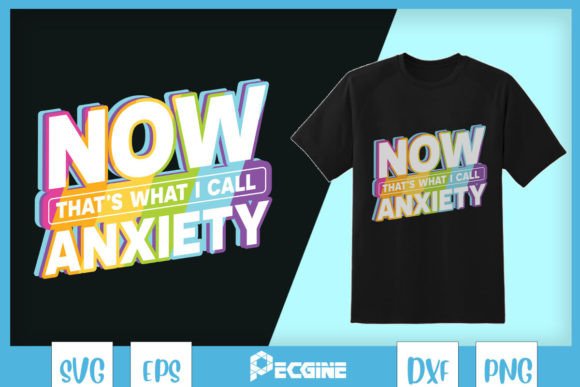
As a graphic designer who’s built brand identities for handmade businesses, launched seasonal print-on-demand collections, and crafted social media graphics for mental wellness coaches, I opened That’s What I Call Anxiety SVG expecting raw, relatable visual tone—not polished perfection. What I found was exactly that: a tightly composed, emotionally resonant illustration that lands with quiet intensity. It’s not decorative filler—it’s a mood anchor. The linework balances nervous energy with intentional restraint; the typography feels handwritten but legible, slightly uneven but never chaotic. This isn’t clipart. It’s a considered graphic design asset built for real creative work.
A First Impression That Fits Real Client Needs
I reviewed That’s What I Call Anxiety SVG while developing visuals for a boutique Etsy shop launching a “Mindful Moments” collection—think ceramic mugs, tote bags, and limited-run t-shirts centered on gentle self-awareness. The client wanted authenticity over cliché, warmth without saccharine softness. This SVG delivered immediately: its off-kilter rhythm, subtle texture in the letterforms, and compact composition made it feel human-made, not algorithm-generated. It doesn’t shout—it leans in. That makes it ideal for small business branding, especially for creators in mental health, journaling, therapy-adjacent products, or slow-living lifestyle brands.
Where It Shines in Commercial Design
In practice, That’s What I Call Anxiety SVG performs exceptionally well across high-impact touchpoints:
- Product mockups: Stands out cleanly on black cotton tees, ceramic mugs, and kraft paper tote bags—especially when placed as a centered chest graphic or subtle sleeve accent.
- Social media graphics: Scales beautifully for Instagram posts and Pinterest pins; works as a focal point in Canva templates or editorial-style quote cards.
- Printable design: The included high-res PNG with transparent background prints crisply at 8×10” for wall art, and the SVG holds sharp edges even at 24×36” for posters or event signage.
- Cricut projects & sublimation design: The clean vector paths and minimal anchor points make it highly editable and reliable for cut files—no jagged edges or rendering hiccups.
- Packaging design: Adds expressive character to product labels, sticker seals, or thank-you card accents without overwhelming minimalist packaging.
It also integrates thoughtfully into broader brand identity systems—not as a logo (it’s too text-heavy), but as a supporting illustration or campaign motif. Paired with a clean sans serif for body copy or a warm script font for headings, it creates visual contrast that feels intentional, not accidental.
Where Caution Is Warranted
This isn’t a universal-fit asset. Use That’s What I Call Anxiety SVG carefully in contexts demanding extreme clarity or formal authority:
- Small sizes: Below 1.5 inches wide, fine details in the hand-drawn lettering begin to blur—avoid for tiny tag labels or app icons.
- Crowded layouts: Its emotional weight competes in busy compositions. Don’t layer it over dense photo backgrounds or complex patterns without generous negative space.
- Corporate or B2B branding: While increasingly common in progressive HR or wellness-forward workplaces, it may undermine perceived professionalism in finance, legal, or enterprise tech contexts.
- Low-contrast environments: Test rigorously on light gray or pastel backgrounds—the thin strokes can fade without sufficient contrast.
Designer Notes You’ll Actually Use
Before locking it into a client file, I always run these checks—and recommend you do too:
- Test in black and white: Confirm legibility and tonal balance without color reliance.
- Preview on both light and dark backgrounds: Especially critical for web design and digital ads where background context shifts.
- Scale it down to 12px and up to 48pt: See how the rhythm holds—or breaks—at extremes.
- Drop it onto real product mockups: A flat PNG preview lies; a textured t-shirt or matte mug reveals how texture and scale truly interact.
- Verify print quality: Run a test print on your intended substrate—some inkjet printers soften fine lines more than laser or DTG.
- Inspect the PNG transparency: Ensure no stray pixels or anti-aliasing halos compromise clean edges on dark surfaces.
- Open the SVG in Illustrator or Affinity Designer: Confirm all paths are ungrouped and editable—no embedded raster elements hiding in the vector file.
- Pair it with fonts: Try it beside Montserrat, Playfair Display, Pacifico, and a tight monospace—notice how hierarchy shifts with each.
- Confirm commercial license terms: This is non-negotiable. For That’s What I Call Anxiety SVG, verify it permits use in client-facing digital product, print-on-demand, and resale-ready Etsy product contexts.
Why It Belongs in Your Creative Marketplace Toolkit
In a sea of generic quote graphics and overused anxiety-themed clipart, That’s What I Call Anxiety SVG stands apart through restraint and resonance. It doesn’t exploit emotion—it reflects it with nuance. As a t-shirt design, it connects instantly. As a sticker design or social media graphic, it invites pause. As part of a design bundle for a mental wellness course or journal launch, it adds cohesion without repetition. Its included formats—SVG, high-res PNG, and DXF—cover nearly every production need: from Cricut projects to web design to large-format printing. It’s not just another SVG design. It’s a ready-to-deploy piece of visual empathy, engineered for impact, tested in real workflows, and built for the quiet confidence that defines strong modern design.